
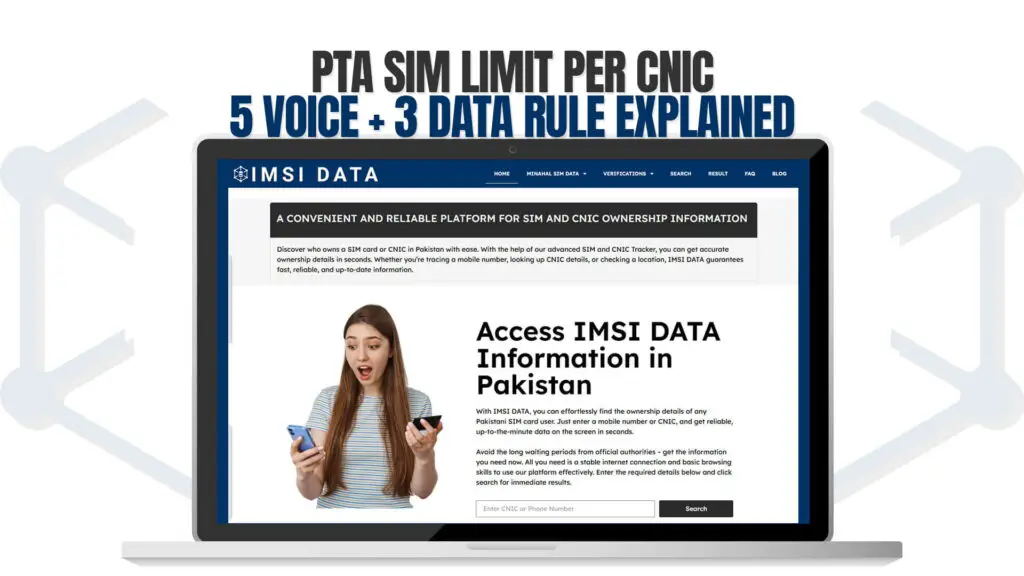
How many SIM cards can one person legally hold in Pakistan? The answer, set by the Pakistan Telecommunication Authority (PTA), is clear: 5 voice SIMs and 3 data SIMs per CNIC — a combined maximum of 8 connections across all mobile operators. Go over that limit, and the consequences can be severe, including automatic suspension of your connections.
This guide explains the 5+3 SIM rule in full: what counts as a voice SIM versus a data SIM, how the limit is enforced, what happens if you exceed it, and how to stay compliant. As a PTA-approved platform officially recognized by the Pakistani Government, IMSI DATA helps you check how many SIMs are tied to your CNIC so you never breach the limit by accident.
Quick Answer: What Is the PTA SIM Limit Per CNIC?
PTA allows each CNIC a maximum of 5 voice SIMs and 3 data SIMs — 8 connections in total — combined across all operators (Jazz, Zong, Telenor, Ufone, and others). The limit is enforced automatically. If your CNIC exceeds it, the system can suspend SIMs registered to you, sometimes including your primary number, until the excess is disowned.
In short: voice and data SIMs are counted separately, capped at 5 and 3 respectively, and the total is enforced across every network together, not per operator.
Voice SIMs vs Data SIMs: What’s the Difference?
Understanding the two categories is key to staying within the rule:
- Voice SIMs are your standard mobile connections used for calls, SMS, and mobile data on a phone. You can hold up to 5 of these acro
- Data SIMs are data-only connections — typically used in mobile broadband (MBB) devices, dongles, MiFi units, tablets, and IoT devices. You can hold up to 3 of these.
The two pools are separate. Having five voice SIMs does not stop you from also holding three data SIMs, but you cannot exceed either category, and the combined ceiling is eight. Mobile broadband and data-only connections count toward the data total. To see your current breakdown, start with our guide on how many SIMs are registered on your CNIC.
Why Does PTA Limit SIMs Per CNIC?
The cap is a deliberate anti-fraud measure. By restricting how many connections a single identity can hold, PTA makes mass SIM fraud harder and more expensive for criminals. The rule serves several purposes:
- Curbing fraud and scams. Unlimited SIMs per person would make it easy to run financial scams, harassment campaigns, and fake registrations at scale.
- Disrupting organized crime. SIM fraud has been linked to financial scams and other organized criminal activity; limiting numbers makes these operations harder.
- Encouraging clean records. The cap nudges citizens to keep only the connections they actually use, keeping the national registry accurate.
- Protecting identities. Fewer SIMs per CNIC means a smaller attack surface for identity theft.
The limit works alongside biometric verification and automated enforcement to keep Pakistan’s telecom ecosystem secure. For the wider identity context, see our guide to SIM and CNIC owner details online.
How the Limit Is Enforced
Enforcement is automated. PTA’s monitoring systems continuously track every active SIM against its registered CNIC. When a CNIC crosses the 5+3 threshold, the system responds — typically without human intervention or advance warning.
Crucially, exceeding the limit can trigger suspension of all SIMs registered to that CNIC until the excess connections are formally disowned. That means a single unauthorized SIM activated in your name could push you over the line and put even your primary number at risk. This is why the limit and the broader fight against unauthorized registration are tightly linked.
The Danger of Unauthorized SIMs
Here’s the scenario that catches people off guard: you personally use four SIMs, well within the limit. But unknown to you, criminals have registered three more on your CNIC using captured biometrics or a stolen identity. Your count is now seven voice SIMs — over the 5-voice cap — and the system suspends your connections, including the number you rely on every day.
This is exactly why the SIM limit makes regular self-verification essential. You can’t manage a limit you can’t see. A reverse check of every connection tied to your identity is the fastest way to catch a rogue SIM — see our CNIC reverse lookup to check SIMs linked to your CNIC.
How to Check How Many SIMs Are on Your CNIC
There are two official, free methods, plus the speed of a verified ownership platform:
1. SMS to 668
Send your 13-digit CNIC (no dashes) to 668. You’ll receive a per-operator count of all SIMs registered to your CNIC across networks, plus the combined total. Note: this shows counts, not individual numbers.
2. The Official PTA Portal
Enter your CNIC on the official SIM Information System portal to view your registered connections per network.
3. IMSI DATA for Fast Ownership Details
For a quick, reliable, and up-to-date view of SIM and CNIC ownership information, use IMSI DATA. As a PTA-approved platform, it helps you confirm your registrations fast so you can act before a count problem becomes a suspension. For more on linking SIM and CNIC ownership data, see our guide on SIM information with CNIC online.
Tip: Save a dated screenshot each month. Comparing month to month is the easiest way to spot an unauthorized SIM the moment it appears.
What to Do If You Exceed the Limit
If your count is over the cap, act quickly:
- Identify the excess. Compare the SIMs you actually use against the total shown. Any extras are candidates for disowning.
- Separate genuine from unauthorized. Decide which surplus SIMs are yours to give up and which you never registered.
- Visit each operator’s franchise. Disowning is handled network by network — go to each relevant operator with your original CNIC.
- Disown the excess. Complete biometric verification and the disowning form to remove the surplus or unauthorized SIMs.
- Re-check after 24–48 hours. Confirm via 668 that your count is back within the limit.
- Report fraud if applicable. If unknown SIMs were involved, file a complaint to create a dated record and consider a police report for multiple unauthorized registrations.
You cannot activate a new SIM while over the limit, so clearing the excess also restores your ability to add a legitimate connection later.
A Common Myth: “The Limit Is 25” (or “6”)
Two pieces of misinformation circulate online. The first claims you can hold 5 SIMs per operator, implying a total of 25 — this is an outdated figure and incorrect. The second claims PTA cut the total to 6; this lacks any official PTA notification or credible confirmation and should be treated as an unverified SEO claim.
The accurate, official position is 5 voice + 3 data = 8 combined across all operators. Always rely on official PTA channels and PTA-approved platforms rather than rumor.
How IMSI DATA Helps You Stay Within the Limit
The 5+3 rule only protects you if you can see your count clearly. IMSI DATA, a PTA-approved platform recognized by the Pakistani Government, gives you fast, reliable, and up-to-date SIM and CNIC ownership details so you can:
- Check exactly how many SIMs are linked to a CNIC.
- Spot any unauthorized connection pushing you toward the limit.
- Keep a clean record and avoid surprise suspensions.
Staying within the limit isn’t about counting your own SIMs — it’s about catching the ones you didn’t authorize. Continuous monitoring is the simplest way to do that.
Tips to Stay Compliant With the SIM Limit
- Audit your count monthly via 668 or a PTA-approved check.
- Disown SIMs you no longer use to free up space and stay safe.
- Guard your biometrics so no one can register SIMs in your name.
- Act fast on any extra SIM before it triggers suspension.
- Keep dated records of your checks for evidence.
- Renew an expired CNIC before attempting any disowning.
A maximum of 5 voice SIMs and 3 data SIMs — 8 connections in total — combined across all operators.
Combined. The 5 voice and 3 data caps apply across all networks together, not per operator.
Voice SIMs are standard connections for calls, SMS, and data on a phone. Data SIMs are data-only connections used in MBB devices, dongles, tablets, and similar devices.
The system can automatically suspend SIMs registered to your CNIC — sometimes including your primary number — until you disown the excess.
Yes. A SIM registered in your name without your knowledge can take you over the cap and trigger suspension of your connections.
Send your 13-digit CNIC (no dashes) to 668, use the official PTA portal, or check quickly through a PTA-approved platform like IMSI DATA.
No. The “25” figure (5 per operator) is outdated and incorrect. The official limit is 5 voice + 3 data = 8 combined.
Final Word
The PTA SIM limit — 5 voice plus 3 data per CNIC — is one of the most practical rules every Pakistani mobile user should know. It exists to fight fraud and protect identities, but it cuts both ways: a single unauthorized SIM can push you over the cap and suspend even the number you depend on.
The defense is visibility. Know your count, catch unauthorized SIMs early, and keep your record clean. With a PTA-approved platform like IMSI DATA delivering fast, reliable SIM and CNIC ownership details, staying within the 5+3 limit becomes a simple monthly habit — and a powerful shield against SIM-related fraud.