
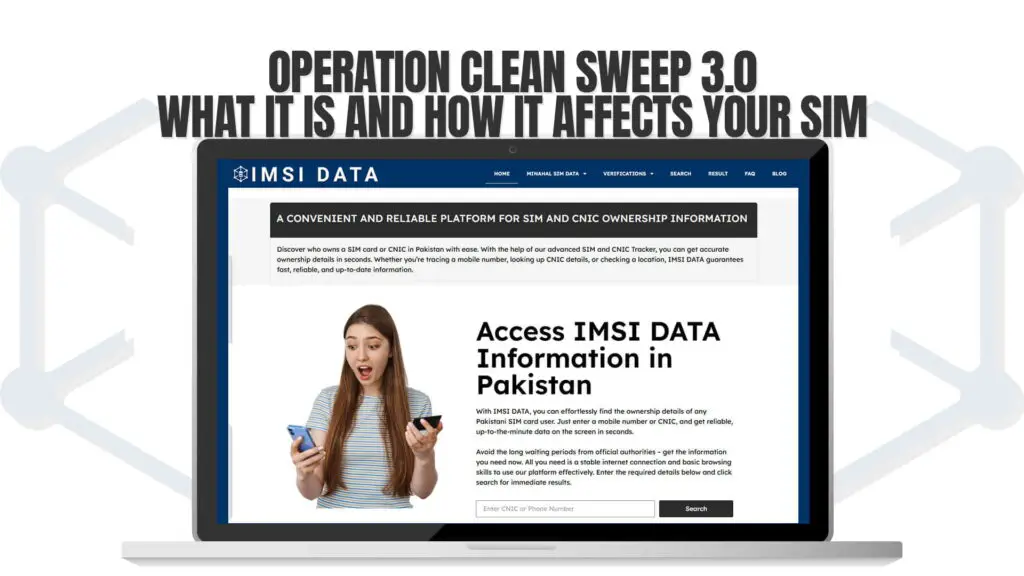
In February 2026, the Pakistan Telecommunication Authority (PTA) launched Operation Clean Sweep 3.0 — the most aggressive SIM-cleanup enforcement drive Pakistan has seen. In its first quarter alone, the operation auto-suspended around 3.1 million SIMs, and unlike earlier efforts, it now works automatically: a non-compliant SIM can be suspended within 72 hours, with no manual review and no advance warning.
If you own a SIM in Pakistan, this affects you directly. This guide explains what Operation Clean Sweep 3.0 is, which SIMs it targets, how to check whether yours is at risk, and what to do if a connection gets caught in the sweep. As a PTA-approved platform officially recognized by the Pakistani Government, IMSI DATA helps you monitor the SIMs tied to your CNIC so you are never caught off guard.
Quick Answer: What Is Operation Clean Sweep 3.0?
Operation Clean Sweep 3.0 is PTA’s quarterly automated enforcement protocol, launched in February 2026, that suspends non-compliant SIMs within 72 hours of detection. It targets SIMs with failed or missing biometric verification, connections on expired or deceased-person CNICs, and lines flagged by AI fraud detection. The earlier versions relied on manual review; version 3.0 enforces automatically.
In short: if your SIM falls out of compliance, the system can cut it off fast — so keeping your biometric status current is now essential.
Why “3.0”? A Quick Background
Pakistan has run SIM-cleanup drives for years to purge illegal, fraudulent, and unverified connections from the national registry. Earlier phases removed millions of SIMs tied to deceased persons, cancelled cards, and expired CNICs, and required human review before action.
Operation Clean Sweep 3.0 marks a turning point: enforcement is now automated and continuous. PTA’s system constantly scans the registry, and when a SIM fails a compliance check, suspension can follow within 72 hours. The goal is a cleaner, fraud-resistant database where every active connection is genuinely tied to a verified, living, legitimate CNIC holder.
Which SIMs Does Operation Clean Sweep 3.0 Target?
The operation focuses on connections that signal risk or non-compliance:
- Failed biometric re-verification. SIMs whose biometric records are outdated, missing, or failed to match NADRA.
- Deceased-person CNICs. Connections still active on the identity of someone who has passed away, verified through NADRA death notifications.
- Expired CNICs. SIMs on identity cards that are well past their expiry date (typically beyond the grace period).
- AI-flagged fraud patterns. Lines showing unusual activation or usage behavior detected by automated fraud systems.
- Repeated authentication failures. Numbers with multiple failed verification attempts.
A large pool of SIMs flagged on deceased or expired CNICs forms the active risk set, and the automated system works through it continuously. To understand the broader identity picture behind these checks, see our guide on checking CNIC information online.
The 72-Hour Window: Why Speed Matters
The defining feature of Operation Clean Sweep 3.0 is its 72-hour automated action window. Previously, a flagged SIM might sit in a queue for manual review, giving owners time to react. Now, once a SIM is flagged as non-compliant, suspension can be triggered within three days — automatically.
During suspension you cannot make calls, send SMS, or use mobile data. For anyone relying on their number for banking OTPs, work, or two-factor authentication, even a short suspension is disruptive. That short window is exactly why proactive checking — rather than waiting for a problem — is the only reliable defense.
How to Check If Your SIM Is at Risk
You can confirm your SIM’s biometric compliance for free in under a minute:
- Send your CNIC to 6001 (Jazz) from the SIM you want to check.
- Send V to 7911 (Zong / Ufone).
- Send your CNIC to 7751 (Telenor).
You will receive a status showing whether your biometric data is synced, pending, or failed. A failed or unverified result means you should visit your operator’s franchise within the 72-hour window to avoid suspension.
Separately, check how many SIMs are registered to your CNIC by sending your 13-digit CNIC (without dashes) to 668, or by using the official portal. Knowing your full footprint helps you spot a rogue SIM that could drag your whole account into non-compliance. Our detailed guide on how many SIMs are registered on your CNIC walks through reading the results.
What Happens If Your SIM Gets Suspended
If a connection is caught in the sweep, restoration is usually straightforward for a legitimate SIM:
- Confirm the status. Use the biometric check codes above to verify the SIM is suspended for a compliance reason.
- Gather documents. Bring your original, valid CNIC (renew first if expired).
- Visit the franchise. Go to your operator’s authorized franchise or Customer Service Center.
- Complete fresh biometric verification. A new thumbprint scan (and, increasingly, a facial scan) is matched against NADRA.
- Wait for reactivation. Service is typically restored within about 24 hours of successful verification.
- Re-check. Confirm your status updated to verified.
If the suspended SIM is one you do not recognize, treat it as a fraud signal: file a complaint, document everything, and have it disowned through the operator. A reverse check of connections linked to your identity helps you confirm what is genuinely yours — see CNIC reverse lookup to check SIMs linked to your CNIC.
The SIM Limit Connection
Operation Clean Sweep 3.0 also enforces SIM limits. PTA permits a maximum of 5 voice SIMs and 3 data SIMs per CNIC across all operators combined. If an unauthorized SIM pushes your CNIC over the limit, the system can suspend connections — sometimes including your primary number — until the excess is disowned.
This is why a single rogue SIM is dangerous: it doesn’t just sit there, it can trigger enforcement against your whole account. Regular monitoring keeps your count clean and your primary line safe. For a full ownership overview, see our SIM and CNIC owner details guide for 2026.
How IMSI DATA Helps You Stay Ahead of the Sweep
The 72-hour window rewards people who check early. IMSI DATA, a PTA-approved platform recognized by the Pakistani Government, gives you fast, reliable, and up-to-date SIM and CNIC ownership details so you can:
- See which SIMs are linked to a CNIC at a glance.
- Catch an unverified or unauthorized connection before automated enforcement does.
- Keep a current record so you can act within the narrow compliance window.
Combine your operator biometric-status checks with regular ownership monitoring, and Operation Clean Sweep 3.0 becomes something you stay ahead of — not something that surprises you. The complete process is covered in our guide to NADRA CNIC verification.
Practical Tips to Stay Compliant
- Check biometric status monthly using your operator’s code.
- Keep your CNIC valid — renew before it expires, or you cannot re-verify.
- Audit your SIM count via 668 to stay within the 5+3 limit.
- Act within 72 hours of any “Not Verified” result.
- Disown unknown SIMs immediately to protect your primary line.
- Save dated screenshots of every check as a record.
It is PTA’s automated quarterly enforcement drive, launched in February 2026, that suspends non-compliant SIMs within 72 hours of detection.
PTA reported around 3.1 million SIMs auto-suspended in the first quarter of 2026.
SIMs with failed or missing biometric verification, connections on expired or deceased-person CNICs, and lines flagged by AI fraud detection.
A flagged SIM can be suspended automatically within 72 hours, with no advance warning.
Send your CNIC to 6001 (Jazz), V to 7911 (Zong/Ufone), or your CNIC to 7751 (Telenor) to see your biometric status.
Visit your operator’s franchise with your original CNIC, complete fresh biometric verification, and service is usually restored within about 24 hours.
Yes. If unauthorized SIMs push your CNIC over the 5+3 limit, the system can suspend connections — potentially including your main line.
Final Word
Operation Clean Sweep 3.0 is a clear signal: Pakistan’s telecom regulator is enforcing SIM compliance automatically, quickly, and at scale. For honest subscribers, the operation is nothing to fear — but its 72-hour, no-warning design means you cannot afford to be passive.
The winning strategy is simple: keep your biometrics verified, your CNIC current, and your registrations monitored. With a PTA-approved platform like IMSI DATA giving you fast, reliable SIM and CNIC ownership details, you can spot trouble early and act within the window — keeping your connections active and your identity protected.